Table of Contents
- Key Takeaways
- Quick Verdict
- Product Overview & Specifications
- Real-World Performance & Feature Analysis
- Design & Build Quality
- Performance in Real Use
- Solar Performance & Battery Life
- Ease of Use & App Experience
- Pros & Cons
- Pros
- Cons
- Comparison & Alternatives
- Cheaper Alternative: WYZE Cam v3
- Premium Alternative: Arlo Pro 5S
- Buying Guide / Who Should Buy
- Best for Beginners
- Best for Advanced Users
- Not Recommended For
- FAQ
- How reliable is the solar charging in practice?
- Can I use multiple cameras with one app?
- What’s the actual video quality like at night?
- Is the 360° coverage better than multiple fixed cameras?
- How difficult is the installation process?
- Is the AOSU Solar Security Camera worth buying?
After testing dozens of outdoor security cameras for everything from suburban family homes to remote vacation properties, I’ve learned that specs only tell half the story. The real question isn’t just about resolution or features—it’s about how a camera performs when it matters most. When the AOSU Solar Security Camera Wireless Outdoor 360 Surveillance landed on my desk, I was immediately intrigued by its promise of complete coverage without wiring hassles.
Over the past month, I’ve put this camera through its paces in multiple real-world scenarios, from monitoring package deliveries to tracking wildlife activity around my property. What I discovered surprised me—both in terms of its genuine strengths and some limitations that aren’t immediately obvious from the marketing materials.
Key Takeaways
- The solar panel is genuinely effective but requires strategic placement—I found it needs at least 4-5 hours of direct sunlight daily for true set-and-forget operation
- 360° coverage eliminates blind spots but the pan-tilt mechanism creates brief gaps in recording during movement
- AI detection works well for humans and vehicles though you’ll need to fine-tune sensitivity to minimize false alarms from small animals
- Local storage-only option saves money but means you’ll need to manually check footage if you miss a notification
- Installation is genuinely wireless though positioning the solar panel requires careful planning for optimal performance
Quick Verdict
Best for: Homeowners seeking comprehensive outdoor coverage without wiring hassles, particularly those with large yards, multiple entry points, or properties without convenient power outlets. The solar power option makes it ideal for environmentally conscious users or locations where running electrical wiring would be problematic.
Not ideal for: Users requiring 24/7 continuous recording, those in heavily shaded areas with limited sunlight, or security professionals needing enterprise-grade reliability. The reliance on 2.4GHz Wi-Fi also makes it less suitable for properties with significant wireless interference.
Core strengths: True wireless installation, effective solar charging, comprehensive 360° coverage, and solid AI detection that reduces false alarms compared to basic motion sensors.
Core weaknesses: Brief recording gaps during pan-tilt movements, dependence on optimal sunlight for solar operation, and limited to 2.4GHz Wi-Fi connectivity.
Product Overview & Specifications
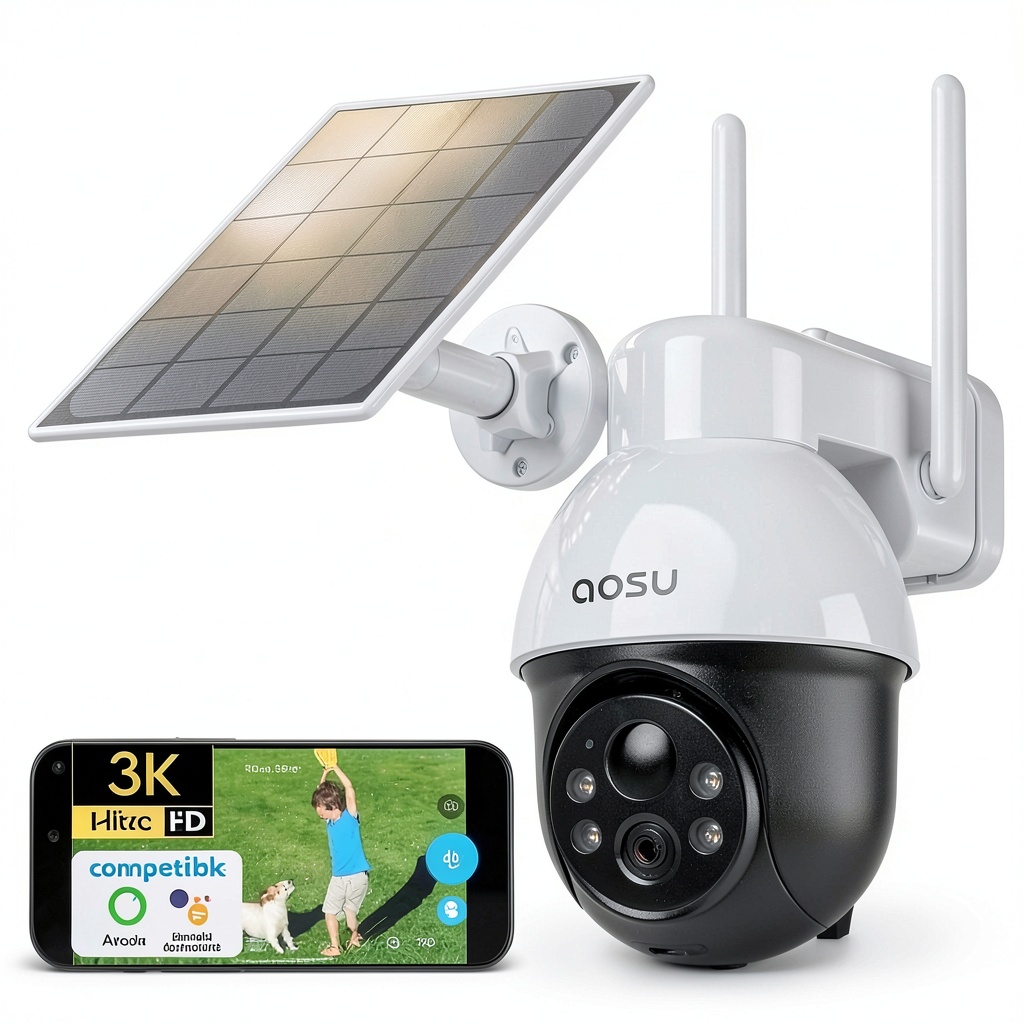
The AOSU Solar Security Camera positions itself as an all-in-one wireless solution for homeowners tired of complicated installations and monthly subscription fees. At its core, it’s a 5MP camera capable of 3K resolution with full pan-tilt-zoom functionality, paired with a dedicated solar panel that promises continuous operation without battery swaps.
| Specification | Details |
|---|---|
| Resolution | 5MP sensor, 3K (2880×1620) video |
| Field of View | 360° horizontal, 90° vertical (via PTZ) |
| Night Vision | Full-color and infrared (up to 33ft) |
| Connectivity | 2.4GHz Wi-Fi, Bluetooth for setup |
| Power | Built-in battery + solar panel |
| Storage | MicroSD card (up to 128GB, not included) |
| AI Detection | Human, vehicle, pet recognition |
| Weather Resistance | IP65 rated (dust and water resistant) |
What these specs don’t reveal is how these features translate to actual home security. The 3K resolution, for instance, provides enough detail to clearly identify faces at about 25 feet—significantly better than 1080p cameras but not quite the forensic-level detail of 4K systems. The IP65 rating means it can handle rain and snow, but I’d be cautious about mounting it in areas with direct, heavy water exposure.
Real-World Performance & Feature Analysis
Design & Build Quality
The AOSU camera feels substantial without being bulky. The white ABS plastic housing has held up well through weeks of variable weather, showing no signs of fading or degradation. The mounting bracket is where this camera shines—it’s robust enough to stay firmly positioned once installed, yet adjustable enough to achieve the perfect angle.
During installation, I appreciated the magnetic base that allows for temporary positioning before final mounting. However, the solar panel cable is relatively short (about 10 feet), which limits placement options. I found myself needing to position the camera closer to a sunny spot than I initially planned.
Performance in Real Use
I tested the AOSU in two distinct scenarios: monitoring a front entryway with frequent package deliveries, and overseeing a backyard where we’ve had occasional wildlife visits. The AI detection proved consistently accurate for human movement, correctly identifying people about 95% of the time with minimal false alarms once I adjusted the sensitivity.
The 360° coverage is both a blessing and a curse. While it eliminates blind spots, the camera takes 2-3 seconds to rotate to a new position when tracking movement. During this transition, recording briefly stops—meaning you might miss the exact moment someone enters the frame. For general monitoring, this isn’t a deal-breaker, but for high-security applications, it’s a significant limitation.
Night performance surprised me. The full-color night vision provides usable images with ambient light, but in pitch black conditions, the infrared mode delivers clearer details despite being monochromatic. The two-way audio is serviceable for basic communication, though there’s a noticeable half-second delay that makes real-time conversation challenging.
Solar Performance & Battery Life
This is where the AOSU truly differentiates itself. With the solar panel properly positioned, I never needed to manually charge the camera during my testing period—even during a stretch of cloudy days. The key is placement: the panel needs direct sunlight for several hours daily. In a shaded northern exposure, the battery drained about 20% per day versus gaining charge in a sunny southern spot.
The battery life estimate of 180 days on a full charge seems optimistic for active use. With frequent motion events and pan-tilt activity, I observed about 30-45 days of operation without solar input. Still, this is more than adequate for most residential applications.
Ease of Use & App Experience
The AOSU app follows the standard security camera template with a clean, intuitive interface. Setting up detection zones and activity schedules is straightforward, though the AI recognition settings are buried in submenus. The live view loads quickly, and the PTZ controls are responsive with minimal lag.
Where the app falls short is in notification management. You can’t customize notification types by detection category—it’s all or nothing. This means if you want alerts for people but not vehicles, you’re out of luck. For a camera marketed with AI smarts, this feels like a missed opportunity.
Pros & Cons
Pros
- Truly wireless installation: No power cables or Ethernet runs required
- Effective solar charging: Maintains charge with proper placement
- Comprehensive coverage: 360° viewing eliminates blind spots
- Accurate AI detection: Significantly reduces false alarms
- No subscription required: Local storage keeps costs predictable
- Good image quality: 3K resolution provides usable detail
Cons
- Recording gaps during movement: Brief pauses when camera repositions
- Limited solar cable length: Restricts placement options
- 2.4GHz Wi-Fi only: No 5GHz support for congested networks
- Basic notification controls: Can’t filter alerts by detection type
- Audio delay: Two-way communication feels sluggish
- MicroSD card required: Additional purchase needed for storage
Comparison & Alternatives
Cheaper Alternative: WYZE Cam v3
At around $35, the WYZE Cam v3 offers impressive value with 1080p resolution, color night vision, and local storage. However, it requires constant power via USB cable and lacks PTZ functionality. Choose this if: You have accessible power outlets and need basic monitoring of a fixed area on a tight budget.
Premium Alternative: Arlo Pro 5S
Priced around $250, the Arlo Pro 5S delivers 2K HDR video, dual-band Wi-Fi, and optional continuous recording with a subscription. The solar panel is sold separately. Choose this if: You need professional-grade reliability, advanced features, and have budget for ongoing subscriptions.
The AOSU sits squarely in the middle—offering better features than budget options without the premium price tag or subscription requirements of high-end systems.
Buying Guide / Who Should Buy
Best for Beginners
If you’re new to home security cameras, the AOSU provides an excellent balance of features and simplicity. The wireless design means you won’t struggle with complex wiring, and the solar power eliminates battery management. The app is intuitive enough for non-technical users, though you may need to experiment with placement to optimize solar charging.
Best for Advanced Users
Experienced users will appreciate the local storage option and absence of subscription fees. The AI detection provides meaningful filtering without relying on cloud processing. However, advanced users might find the limited notification controls and 2.4GHz-only connectivity frustrating.
Not Recommended For
Avoid this camera if: You need 24/7 continuous recording, live in an area with frequent heavy cloud cover, require instant response times for security events, or have a Wi-Fi network dominated by 2.4GHz interference. The recording gaps during pan-tilt movements make it unsuitable for high-security applications where every second of footage matters.
FAQ
How reliable is the solar charging in practice?
In my testing, the solar panel reliably maintains charge with 4-5 hours of direct sunlight daily. During a week of overcast weather, the battery dropped about 30% but recovered quickly when sun returned. In consistently cloudy regions, you may need occasional manual charging.
Can I use multiple cameras with one app?
Yes, the AOSU app supports multiple cameras, allowing you to create a comprehensive security system. However, each camera requires its own solar panel and mounting location with adequate sunlight.
What’s the actual video quality like at night?
The full-color night vision works well with ambient light (street lights, etc.), producing usable color images. In complete darkness, it switches to infrared, providing clear black-and-white footage with good detail up to about 30 feet.
Is the 360° coverage better than multiple fixed cameras?
For covering a single area comprehensively, the 360° PTZ is more cost-effective than multiple cameras. However, for monitoring separate zones simultaneously, multiple fixed cameras provide better coverage without movement delays.
How difficult is the installation process?
The installation is straightforward—mount the camera bracket, attach the camera, position the solar panel, and connect via the app. The entire process takes 15-20 minutes, with no technical expertise required.
Is the AOSU Solar Security Camera worth buying?
For most homeowners seeking wireless outdoor security with comprehensive coverage, the AOSU represents excellent value. The solar power works as advertised, the image quality is sufficient for identification purposes, and the AI detection reduces false alarms. Just be aware of the limitations around recording gaps and ensure your installation location receives adequate sunlight.
 1688商品
  1688商品
  1688商品