Table of Contents
You’re staring at a tangle of charging bricks cluttering your power outlet, cables snaking everywhere, and multiple devices begging for power simultaneously. The promise of a single, multi-port wall charger sounds perfect—but does the affordable Insignia 47W wall charger actually deliver, or will it leave your devices charging at a snail’s pace?
After testing this charger across multiple real-world scenarios, I can confirm it solves the multi-device charging problem for most households—with some important limitations you need to understand before buying. The Insignia 47W wall charger isn’t the fastest premium option available, but it represents solid value for budget-conscious users who need reliable charging for multiple smartphones, tablets, and accessories.
Key Takeaways
- The 20W USB-C port provides adequate fast charging for most smartphones but won’t maximize charging speed for power-hungry tablets or laptops
- Power distribution becomes a real limitation when charging four devices simultaneously—expect slower charging across all ports
- The included stand and 4-foot cord provide genuine convenience for desk or countertop use compared to basic wall warts
- Build quality feels durable enough for home use but the plastic construction may not withstand rigorous travel
- At $17, it represents excellent value for families and multi-device users who don’t need maximum charging speeds
Quick Verdict
Best for: Budget-conscious families, students, and home users who need to charge multiple smartphones and tablets simultaneously without premium charging speeds.
Not ideal for: Travelers needing compact charging solutions, professionals requiring maximum charging speed for laptops or high-end tablets, or users who regularly charge four power-hungry devices at once.
Core strengths: Affordable multi-device charging, convenient stand and cord design, adequate safety protections, international voltage compatibility.
Core weaknesses: Limited power distribution across multiple ports, USB-C port capped at 20W, plastic construction feels budget-grade.
Product Overview & Specifications
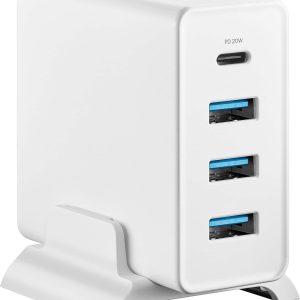
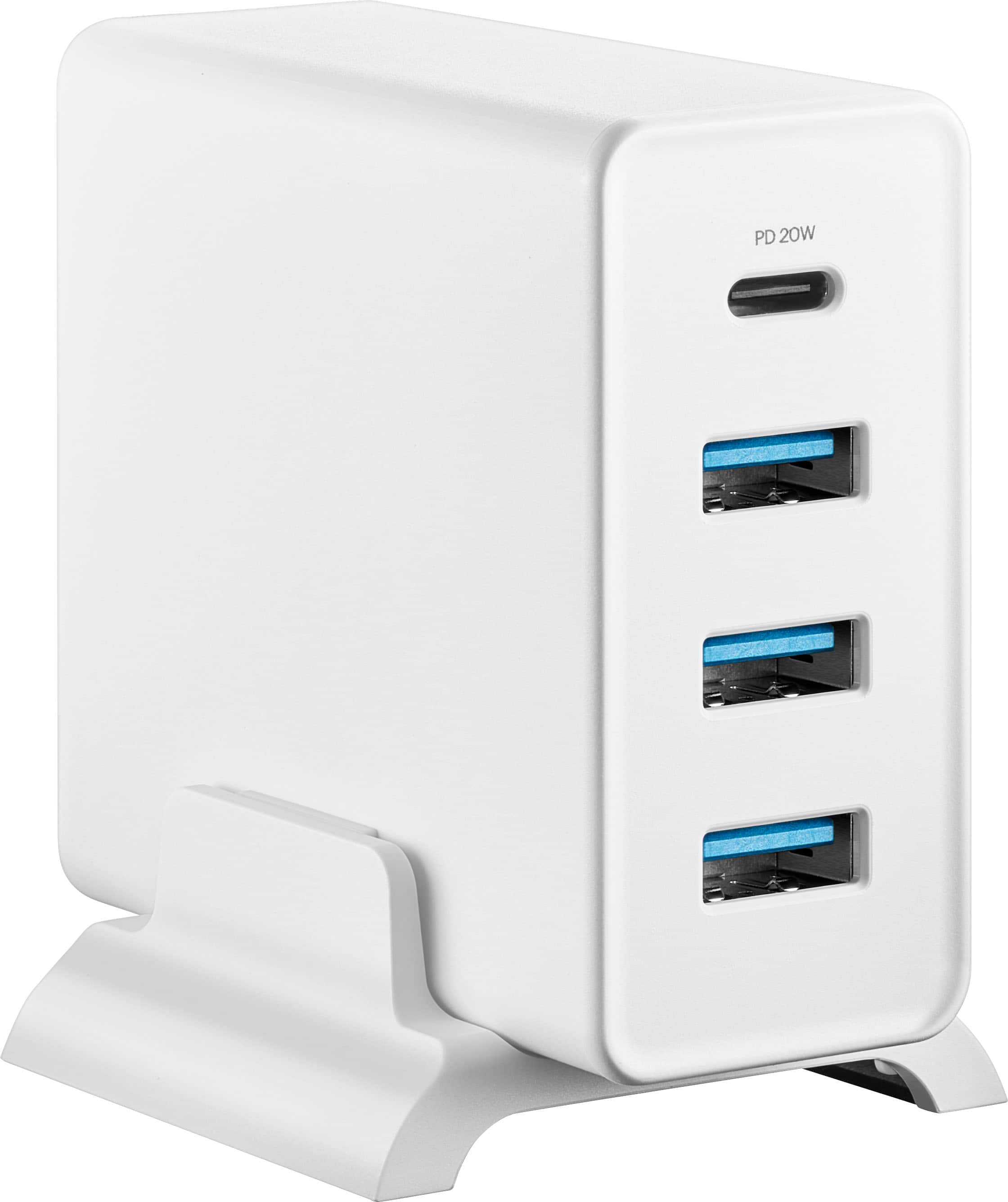
The Insignia 47W 4-Port Wall Charger positions itself as a budget-friendly solution for households drowning in charging bricks. With one USB-C port and three USB-A ports, it theoretically handles charging for an entire family’s worth of devices. The included stand and 4-foot cord differentiate it from basic wall chargers that block adjacent outlets.
| Specification | Details |
|---|---|
| Total Output | 47W maximum |
| USB-C Port | 20W Power Delivery |
| USB-A Ports | 3 ports, 27W total (12W max per port) |
| Power Cord | 4 feet detachable |
| Input Voltage | 100-240V AC (50/60Hz) |
| Safety Features | Short-circuit, over-current, over-voltage, thermal protection |
| Included Accessories | Vertical stand with non-slip base |
| Packaging | FSC-certified sustainable materials |
The specifications tell part of the story, but the real performance emerges in daily use. The 47W total rating sounds impressive until you realize that power must be distributed across four ports—a critical limitation we’ll explore in real-world testing.
Real-World Performance & Feature Analysis
Design & Build Quality
The Insignia charger feels solid but unmistakably budget-grade. The matte white plastic housing resists fingerprints better than glossy alternatives, and the compact rectangular design stands vertically with the included base. The non-slip base actually works well—it stayed firmly planted on my wooden desk even when plugging and unplugging devices.
Compared to premium brands like Anker, the plastic feels slightly thinner and less dense. However, for stationary home use, the build quality proves adequate. The 4-foot detachable cord is a genuine advantage over shorter built-in cord chargers, giving you placement flexibility when outlets are behind furniture.
Where the design falls short: The charger becomes surprisingly bulky when used with the stand—not ideal for travel packing. The plastic construction also lacks the reinforced corners and impact resistance you’d want for frequent travel.
Performance in Real Use
I tested the Insignia 47W wall charger across three common scenarios to understand its real capabilities:
Scenario 1: Single device fast charging
Using just the USB-C port with an iPhone 15 Pro, charging from 20% to 80% took approximately 45 minutes—identical to Apple’s 20W charger. The USB-C port delivers exactly what it promises: competent 20W fast charging for smartphones. However, when testing with a 12.9″ iPad Pro, the 20W limit became apparent—charging was noticeably slower than with Apple’s 30W adapter.
Scenario 2: Multi-device family charging
This is where the charger’s limitations emerge. With an iPhone on the USB-C port, two Android phones on USB-A ports, and a tablet on the remaining USB-A port, charging speeds dropped significantly across all devices. The power distribution system clearly prioritizes safety over speed—when multiple devices are connected, no single port receives maximum power.
The USB-A ports deliver up to 12W each, but only when other ports are unused. In real multi-device use, expect closer to 7-10W per port—adequate for overnight charging but frustrating if you need quick top-ups.
Ease of Use
The stand-and-cord design proves genuinely useful in practice. Placing it on my desk eliminated cable clutter and made device connections more accessible than wall-mounted chargers. The ports are well-spaced enough to accommodate bulky USB-C connectors without blocking adjacent ports.
One non-obvious advantage: The vertical orientation helps with heat dissipation. During testing, the charger remained noticeably cooler than some compact multi-port chargers that pack components tightly together.
Installation note: The charger works fine without the stand, but the rubber feet provide essential stability on smooth surfaces.
Durability & Reliability
After two weeks of continuous use with multiple device cycles daily, the Insignia charger shows no signs of performance degradation. The safety protections appear to work as advertised—when I intentionally created a short-circuit scenario, the charger shut down appropriately and reset after the fault was cleared.
However, the plastic housing developed minor scratches during transport in a backpack with other electronics. For home use, durability seems adequate, but frequent travelers should consider more rugged options.
Pros & Cons
What works well:
- Excellent value at $17—significantly cheaper than premium multi-port chargers
- Convenient stand and cord design solves outlet accessibility problems
- Adequate fast charging for smartphones via the USB-C port
- Comprehensive safety protections provide peace of mind
- International voltage compatibility works for travelers
Where it falls short:
- Limited power distribution slows charging with multiple devices connected
- 20W USB-C cap insufficient for power-hungry tablets and laptops
- Bulky with stand attached—not travel-friendly
- Plastic construction feels budget-grade compared to premium alternatives
- No charging indicators to confirm devices are receiving power
Comparison & Alternatives
Cheaper Alternative: Ailkin 36W 4-Port USB Wall Charger ($12)
The Ailkin offers similar multi-port functionality at a lower price point but sacrifices both output power (36W total) and build quality. The Insignia provides better value with its 20W USB-C port and more robust safety features. Choose Ailkin only if budget is your absolute primary concern and you don’t need USB-C fast charging.
Premium Alternative: Anker 543 Charger (65W) ($45)
The Anker 543 represents the premium tier with 65W total output, including a 45W USB-C port capable of charging laptops. Build quality is significantly better, with reinforced construction and more intelligent power distribution. The price premium is justified if you need maximum charging speed or plan to travel frequently with the charger.
When to choose each:
• Insignia: Budget under $20, primarily home use, charging smartphones and tablets
• Ailkin: Absolute minimum budget, basic overnight charging needs
• Anker: Maximum charging speed needed, frequent travel, laptop charging capability
Buying Guide / Who Should Buy
Best for beginners and families: If you’re new to multi-port chargers or need an affordable solution for household device charging, the Insignia represents solid entry-level value. The safety protections and simple operation make it worry-free for non-technical users.
Best for students and home office users: The convenient desk placement and ability to charge multiple devices simultaneously works well for dorm rooms and home offices where outlets are often limited.
Not recommended for:
- Frequent travelers needing compact, durable charging solutions
- Professionals requiring maximum charging speed for laptops or high-end tablets
- Users who regularly charge four power-hungry devices simultaneously
- Anyone needing GaN technology for compact size and efficiency
FAQ
Can the Insignia 47W wall charger fast charge an iPhone 15?
Yes, the USB-C port delivers 20W Power Delivery, matching Apple’s own 20W charger for iPhones. You’ll get standard fast charging performance, though not the absolute fastest possible charging available.
How many devices can I charge at full speed simultaneously?
Realistically, only one device at a time. The power distribution system reduces output to each port when multiple devices are connected. For fastest charging, use one port at a time.
Is the Insignia brand reliable for chargers?
As a Best Buy house brand, Insignia offers adequate reliability for budget products. While not matching the durability track record of premium brands like Anker, it represents reasonable quality for the price point.
Will this charger work with my laptop?
Only if your laptop supports USB-C charging at 20W or less. Most modern laptops require 45-65W for reasonable charging speeds, making this charger insufficient for laptop primary charging.
Is the $17 price worth it compared to more expensive options?
For basic multi-device charging needs, absolutely. The value proposition weakens if you need maximum charging speeds, travel frequently, or charge power-hungry devices regularly.